Disability at work: Viaposte opens up the conversation on promoting the inclusion of people with disabilities


According to INSEE, 12 million people are living with a disability in France in 2025, and 1 in 2 French people will face a disability during their lifetime, whether permanent or temporary. As many as 80% of disabilities are ‘invisible’, a fact that demands companies implement a range of measures to combat silent exclusion.
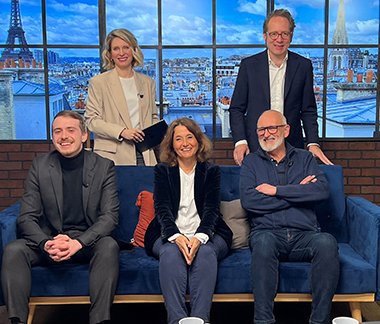
To mark European Disability Employment Week, Viaposte brought together four inspiring speakers on its show, L'Émission, to discuss the realities of disability at work.
For its 4th episode, the programme returned to tackle a topic of great public interest, posing the question “1 in 2 French people will have a disability: what if tomorrow I were one of them?”, and discussing how the company takes concrete actions on a daily basis to address the cause.
Madjid Bouziane : a disability can come without warning
After 30 years of service at Viaposte, Madjid Bouziane saw his daily life change overnight.
“One morning, I couldn’t walk any more. I went to work, everything was fine, but after 2 hours, I started limping.”
As a Team Leader at the Viaposte facility in Le Bourget, Madjid went through a gruelling 5-year ordeal of medical uncertainty, without a concrete diagnosis, even though his disability was very clear and real. Finally, an explanation was found for his suffering: osteoarthritis caused by a childhood operation. “A new surgical intervention allowed me to get back to work, initially on a part-time basis,” he continues.
Nevertheless, his return to work did not go as he had hoped. “My manager didn’t fully grasp my physical difficulties, and my workstation wasn’t sufficiently adapted. I was in constant pain, after spending entire days on my feet, and I faced a lot of judgement. I often had to show my foot and my scars just to prove my disability!” The way others looked at him was very hard for him, even though he admits that, before his disability, he too had certain preconceived notions about disabilities: “I used to think, if you can walk, you’re capable. But in reality, just because something isn’t visible or well-understood doesn’t mean it isn’t very real!”
After obtaining his RQTH, or official recognition as a disabled worker, everything changed. It paved the way for genuine accommodations to be made to his workstation, and facilitated his return to full-time work.
Madjid Bouziane has come to appreciate his luck in being part of a company that adapts to its employees and values keeping people in employment.
Manon Avenet : job retention at the heart of Viaposte’s inclusion strategy
For Manon Avenet, expert and Disability Inclusion Head at Viaposte, 2025 is the year of implementation of a more structured process for job retention.
The primary objective is to support each and every employee whose health impacts their work, to co-create solutions with HR to make their daily lives easier, and to break down prejudices.
To achieve this, Viaposte is relying on several levers:
- Opening up dialogue with colleagues
- Preparing for a return to work and long-term job retention
- Coordinating all of the necessary arrangements
- Working closely with occupational health practitioners
- Involving managers: “The manager’s role is crucial in how the employee experiences the situation,” explains Manon Avenet.
Viaposte is building on this momentum by deploying a wide-ranging awareness campaign for management. This includes a one-hour workshop, entitled ‘Handi Sensi,’ aimed at dispelling common myths associated with disabilities.
The Disability Inclusion Head specifies that the awareness campaign is aimed at all Viaposte employees, and includes the distribution of ’round dice’ to teams, to convey a strong message that serves as a mantra: “Difference is not a barrier to competence.” A round die, once we have adapted to using it, rolls the same numbers as a square one.
Communications are regularly posted on the intranet, many of which focusing on invisible disabilities.

Manon Avenet concludes by announcing that many more actions are planned for 2026 !
Adeline Josse : making the invisible visible
As a Disability Representative and IT Transport Project Manager, Adeline discovered her dysorthography when her son was diagnosed with it.
“Simply put, it is an inability of the brain to master spelling, even when you know the basic rules.”
This invisible disability is often greatly misunderstood, and Adeline Josse opens up about the judgement she has faced: “Sometimes, I would realise that my spelling mistakes had been corrected without me being told, and I found it humiliating.”
She therefore decided to become a Disability Representative at Viaposte, in order to provide guidance and support, also based on her own experience. The Disability Representatives form a network of around fifteen volunteer employees, spread across France and Viaposte’s various sites and teams, and are trained to support the first inquiries and steps of our employees.
Part of her mission is to answer questions from colleagues:
- What actions can I take?
- Does this count as a disability?
- Comment parler à mon manager ou à mes collègues ?
- How do I apply for official recognition as a disabled worker (RQTH status)?
However, it’s important to provide information on the managers’ side too, with a support-oriented approach. Adeline Josse acknowledges the open-mindedness that this implies, and notes that, sometimes, the message gets across better when she takes the initiative under her specific role: “When it comes from a Disability Representative, it’s easier for managers to really hear what the employee is saying.”
Finally, Adeline emphasises the importance of accepting the disability, of accepting one’s own disability, so that things can change: “Then, it’s a win-win situation. You have to dare, to communicate, to be at peace with who you are. Being disabled is not being less, it’s just being different. But different from what?”
Manon Avenet : a focus on official recognition
Manon Avenet, as expert and Disability Inclusion Head, takes up the discussion, wishing to highlight the importance of the official recognition of the disability, and the role that Viaposte plays in this process.
“The RQTH official recognition process is very important, but also very complex. You have to fill out a 20-page form, go see your doctor, and so on. We want to support employees and guide them on the path to accepting their disability and having it officially recognised.”
Viaposte provides its employees with practical resources to facilitate their application. “Practical guides have been developed and are available on our intranet to explain the steps, deadlines, who to see, how it will happen, and everything else,” explains Manon.
“You should reach out to the Disability Representatives whenever you need to, to find out how disability recognition can help you, not just professionally, but personally too.” “This might lead to setting up adjusted work schedules, providing enhanced support to keep you in your job, or adapting your workstation.”
Alice Devès: Breaking down stereotypes about invisible disabilities through the media
Alice Devès suffers from multiple sclerosis, an illness that was already taking a heavy toll on her before her diagnosis. Once a name was put to her illness, she returned to work “as if nothing had happened,” but the impact on her professional and personal life was immediate: “My disability is invisible, and so I faced a lot of judgement, and had to deal with many comments. The hardest thing isn’t always the disability itself, it’s the discrimination you face. You are always having to justify yourself.”
Then came a revelation that marked a turning point in her life: “I realised that there was no media for sharing about disability, so I created Petite Mu, to inform and support disabled people, especially those suffering from invisible disabilities.”
The name Petite Mu was chosen for its double symbolism, not only as short for “immune”, but also as an echo of the French word for the moulting of a snake, representing the stage of transformation that follows the acceptance of a disability.
Through various media, including drawings, videos, testimonials, awareness campaigns and training actions in companies, Alice Devès wishes to break down prejudices around disability, and give a voice to the people directly concerned.
Today, the co-founder of Petite Mu sees that things are changing: “We are talking more about invisible disabilities and mental health, acknowledging that everyone is subject to vulnerabilities in life. However, disability remains the leading cause of discrimination in the workplace. Things still need to change.”
Alice Devès has gathered countless testimonials, but one in particular stands out: that of a Legal Department Director who had Attention Deficit Hyperactivity Disorder (ADHD). Out of fear and shame, he never wanted to tell his colleagues or his superiors that: “I'm in an open space all day, and have trouble staying focused with all the noise. “I work evenings and weekends, and I’m in the middle of a divorce.” This story highlights a strategy of overcompensation and the heavy toll of invisible (and sometimes made invisible) disabilities on one’s personal life.
Alice Devès addresses the need to change mindsets regarding conditions that are widespread in France.
Petite Mu is pressing on with its work, with the goal of continuing to drive a more widespread awareness. “New formats and projects are in preparation, including several books and reports.
Understanding disability means, first and foremost, listening to those who experience it. Viaposte will continue its commitment to disability inclusion in 2026, so that everyone finds their place, without having to prove their legitimacy.
Follow Viaposte’s daily commitments: